Controlled exchange over untrusted networks
Magnesium Secure messaging & file-transfer gateway
A distributed secure messaging architecture for exchanging messages and files between pre-authorized parties without extending a trusted security envelope to every user device.
Controlled exchange over untrusted networks
Secure exchange without a traditional high-security WAN
Magnesium combines centralized management with geographically distributed remote units, reducing administrative overhead while maintaining policy, logging and traceability.
Core characteristics
- Centralized and automated management and policy generation
- Distributed policy enforcement
- Scalable regional or group structures
- Low administrative overhead
- Strong chain of evidence, logging and traceability
- High-reliability system design
- Flexible deployment model
- Security architecture designed around protected cryptographic services
Controlled exchange over untrusted networks
Remote units connected to one or more gateways
An Mg deployment consists of multiple geographically distributed Mg-RU remote units reporting to one or more Mg-GW gateway devices.
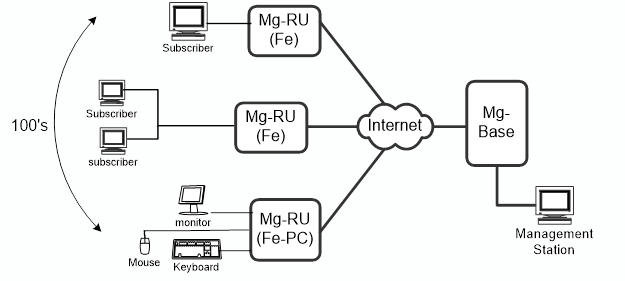
Mg-Fe
- Subscriber access over an untrusted IP network
- Gigabit Ethernet or USB 3.0 mass-storage access from user equipment
- Access control, security policy, queuing and reliable message transfer
- Generates and receives messages and files within the authorized Mg community
Mg-Fe-PC
- Adds an internally secured PC running captive applications in kiosk mode
- Reduces reliance on externally managed subscriber computers
- Supports controlled logon, message creation, attachment upload, message inventory and logout
Controlled exchange over untrusted networks
A hard boundary around the secure messaging zone
Users can employ native COTS tools on their own systems while submitted files cross a controlled boundary into the Mg secure zone.
Controlled file handling
- Files can be submitted from PCs, cameras, DVRs, smartphones and other attached devices
- Submitted files are tagged and retained in native format with filename and extension
- The approach avoids treating user endpoint devices as part of the protected security envelope
- Designed to be simpler to administer than conventional PC-and-VPN arrangements
Discuss Magnesium with Blackline.
Discuss Magnesium secure messaging, distributed remote units, gateway architecture and deployment requirements with Blackline.
Contact Blackline Systems